
Contents
Volunteering & formats
Sportvolunteering
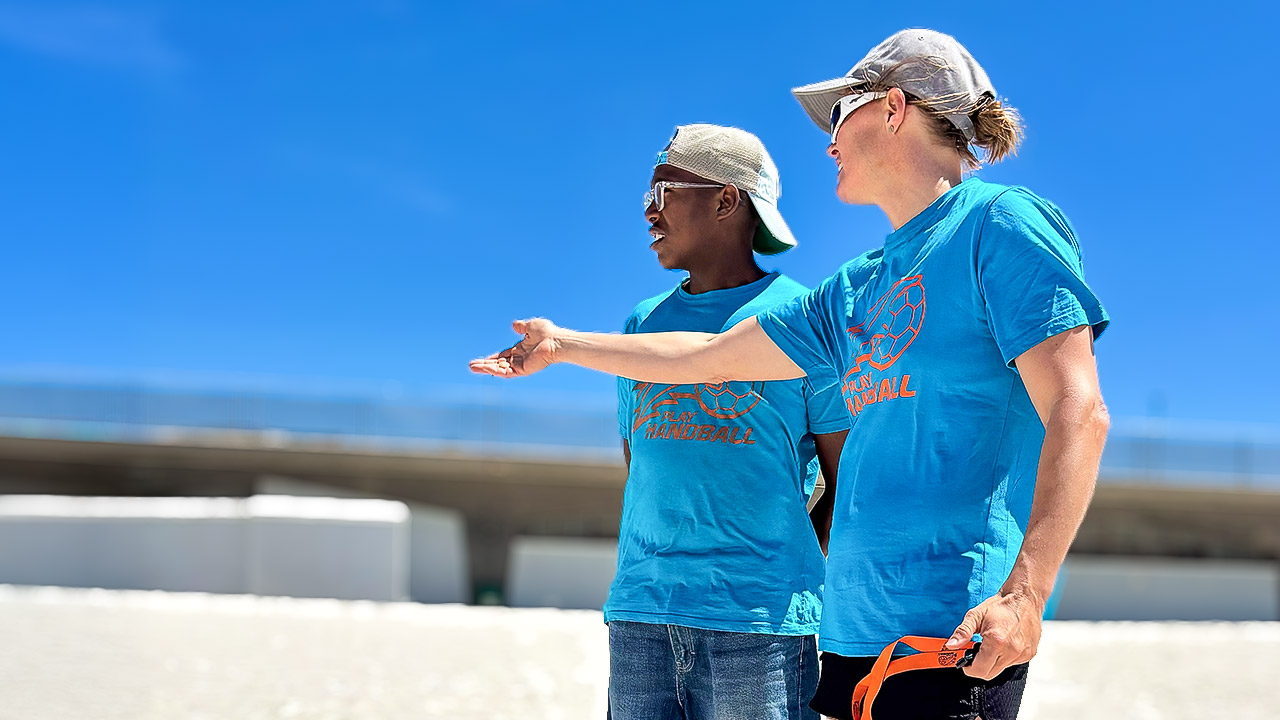
Sports volunteering refers to unpaid, voluntary work as a sports coach in social projects, typically in disadvantaged communities abroad. Sports volunteering can refer to work abroad, but in English-speaking countries it is also a term for voluntary work in your home country. Sport volunteering focuses on sport. Volunteers support local coaches with training, share on their knowledge of a particular sport and help to expand the range of sports available to children and young people in the long term. Sport volunteering combines personal development with a tangible social impact.
Voluntourism
Voluntourism, a portmanteau of ‘volunteer’ and ‘tourism’, describes short-term volunteering assignments that are primarily intended to provide a personal experiences rather than achieve a lasting impacts. Typical stays last from a few days to two weeks and do not require any specific expertise. Offers in which volunteers without educational or professional qualifications work directly with children are viewed particularly critically, as there is a risk that short-term assignments will cause more harm than good. Critics argue that voluntourism can weaken local labour markets, create dependencies and often fail to meet the needs of the local community. Ethically oriented volunteer work deliberately distances itself from voluntourism.
Read more: COACH ABROAD: Where sport meets social impact
Gap Year & Work and Travel
A gap year is a deliberate break – often taken between school and university, between jobs, or as a sabbatical – used for travel, personal growth, or volunteering abroad. Work and Travel is a related concept where travel and paid work are combined, typically on farms, in hostels or through seasonal jobs. Both are popular ways to gain international experience, but neither should be confused with meaningful volunteering: gap year and Work and Travel programmes are primarily self-focused, whereas sports volunteering with COACH ABROAD centres on contributing real skills to communities that benefit from sustained support.
Host family in voluntary service
A host family takes volunteers into their home for the duration of their assignment, typically in exchange for a contribution that benefits the family directly. Staying with a host family is a completely different experience to staying in a volunteer dormitory or hostel: it provides genuine cultural insights, personal connections and first-hand experience of everyday life in the community. A related option is a homestay, which involves living with a local family and is often shared with other volunteers. Living conditions can vary significantly from the standards of the global North, depending on the region and family.
Read more:
Expectations and reality: Host family accommodation
Expectations and reality: Municipal and private basic services
Development & Impact
Sport for Development
Sport for Development (S4D) is an international concept that uses sport as a tool for social, educational and community development. Its primary focus is not on athletic performance, but on promoting values such as team spirit, respect, discipline and self-confidence, particularly among children and young people in disadvantaged regions. S4D measures are based on the UN Sustainable Development Goals (SDGs): sport is a means to an end, not the primary goal – it serves as a gateway to education, health, equality and social participation. S4D is a recognised approach in international development cooperation and is promoted by the UN, the DOSB and GIZ, among others.
Social impact through sport
Social impact through sport refers to the measurable and non-measurable changes that structured sports training can bring about. These include improved concentration and academic performance, increased self-confidence, social integration across ethnic and gender boundaries. In some countries, such as Kenya and Tanzania, it can also provide access to educational support through scholarship programmes. A prerequisite for sustainable impact is a continuous programme with qualified coaches.
Read more: Teamwork, respect, responsibility, health – the positive effects of sport
Helping people help themselves
‘Helping people help themselves’ is a fundamental principle of sustainable development cooperation: external support should strengthen local structures and build skills, rather than permanently replacing what the community can achieve independently. In the context of volunteer sports projects, this means that volunteers fill gaps where there would otherwise be no support. They share their passion, experience and sporting expertise with local coaches, and motivate them to give more children and young people access to sport. By doing so, volunteers make a valuable contribution to intercultural exchange and help to break down stereotypes and prejudices on both sides. Many of COACH ABROAD’s partner projects have developed professional structures over the years and grown independently – yet they continue to benefit from external expertise, fresh impetus and additional manpower.
Read more: Overcoming the challenge of dependency
Project mentor
A project mentor is the local leader behind a social sports project. They are often also the founder, head coach and on-site contact person for volunteers. They are the ones who keep the project alive on a daily basis by knowing the community and understanding the context that volunteers must first learn. Good cooperation with the project mentor is crucial to whether a volunteer assignment really has an impact.
Ethics & Attitude
White Savior Complex
The ‘White Saviour Complex’, also known as ‘white saviourism’, refers to the tendency of privileged people, primarily from the Global North, to present themselves as saviours in contexts of development or aid. Despite their good intentions, they often unconsciously prioritise their own experiences, causing the actual needs of the local community to fade into the background. This phenomenon reinforces power imbalances and promotes stereotypical representations, often leading to short-term, unsustainable interventions.
Read more: The “white saviour complex” in volunteering
Ethical volunteering
Ethical volunteering prioritises the needs of the host community over the experience of the volunteers. It involves sufficient duration to have a real impact, relevant expertise, partnership-based cooperation with local structures, cultural sensitivity and transparency regarding costs and the use of funds. Ethical volunteering is distinct from voluntourism, requiring volunteers to adapt to local culture rather than impose their own ideas.
Read more: Reasons why you should go abroad with COACH ABROAD
Dependency in development projects
In social projects, dependency arises when external support, such as volunteers or donations, replaces local initiative and structures permanently instead of complementing them. A project that only functions while volunteers are present has not developed a sustainable basis. However, the responsibility for this does not lie solely with the donors. Dependency is often the result of a complex interplay of factors, including too short deployment periods, a lack of knowledge transfer and a lack of community involvement in decision-making processes, as well as local conditions that make sustainable structures difficult. Volunteers can help to start projects and build momentum; in the long term, however, it is crucial that local structures take centre stage.
Read more: Overcoming the challenge of dependency